

A general misgiving about the middle ages is the idea that most people were bound to one place, usually a village and so most people did not travel. Yet at most universities this idea has been disputed for a while now. In fact, a great many immigrants travelled far and wide in search of different goals throughout the middle ages. This blog article will explain that medieval people did in fact travel and immigrate regularly.
Medieval immigration through warfare
Strangely it was warfare that brought many medieval cultures together and that had to do with foreign rulers taking over pieces of land where other majorities or minorities were already established. There are countless examples but a clear one would be England. My book the Frisian shows that during the reign of king Edward the Confessor many Danes lived side by side with the English (or Saxons) and the great rulers of the land were therefore multicultural as well. Edward’s predecessor was king Cnut the Great (a Dane), who had conquered England with a Scandinavian army, which in turn meant that many Danes became accepted in the English aristocracy, both on the local elite level as well as the regional one. Northumbria, for one, was ruled by a Dane (by an earl, who was just below the king) both when Cnut and Edward ruled. Through war two cultures had basicallly mixed and because the Danes had won they became accepted local rulers to the English. At the same time the Danes did not wipe out all the English rulers either and so a Dane ruled Northumbria while an Englishman ruled Wessex.
Immigration in medieval Italy
Yet there are even more extreme examples to be found. In southern Italy many cultures lived side by side and it was the arrival of Norman mercenaries that would throw them all in a melting pot that made Sicilian Pamplona the multicultural heartbeat of medieval Europe for most of the twelfth century. Here native Italians lived side by side with Greeks inhabiting the eastern towns of southern Italy, with Bari as the most prominent and longest lived capital. Then there were Muslims that lived in Sicily for a great deal of the eleventh century and there was even a Lombard elite that belonged to none of these groups with capitals in Benevento and Capua, with both enduring far into the eleventh century. All these groups were merged when the Normans took control of the Lombard, Greek and Muslim territories, creating a(n) (even more) multicultural society through warfare. Strangely enough it was in this mix of cultures that were relatively far removed from each other that acceptance proved to be greatest and that made Palermo a home to Muslims, Greeks, Italians and Normans who were all represented in its twelfth century court.
Disappearing frictions
The example above shows how multicultural the middle ages could be and so the collaboration between all these groups is a testament to the human tendency to adept to new situations, even though initial reluctance to ‘that which is different to what one knows’ sometimes creates frictions between cultures. For some reason these frictions always seem to disappear over time, when understanding takes over from suspicions and younger generations get more used to customs their parents consider alien. From ancient Rome to medieval Pamplona to modern day Istanbul, what starts with warfare seems to always result in the same merging of cultures over time.
Medieval immigration to towns
A story of medieval multiculturalism is incomplete without mentioning the towns. Indeed, towns had gotten much bigger over the course of the early middle ages and by the eleventh century some had reached a population that could specialize more and more and that would invite people from different cultures to live together.
Medieval Jews
Throughout medieval Europe there were moneylending Jews to be found , as Christians were not allowed to lend each other money, and they mostly settled in towns to accommodate bankrupt individuals and money craving royals.
Medieval craftsmen
Then there were the craftsmen that came from all over Europe and some cultures would specialize more in one craft than others, meaning that several cultures could live together side by side. For example, eleventh-century Normans were experienced castle builders where the native English had virtually none, and the Normans would build them in towns as well as in the countryside. It can be imagined that English labourers were used by William the Conqueror in 1066 when he started building the first of these fortifications but the knowledgeable people, the ones who had to calculate and plan the actual building, would have come from the continent. Surprisingly this seems to have happened even before the Normans waged war on the English. Indeed my book the Frisian shows how a Continental earl, called Ralph, built a castle at Hereford. It would be logical to say that continental Franks and Normans had to be brought over to help build these earliest castles on English soil. Skilled labour would therefore arrive and be invited in towns when needed and this in turn could invite multicultural exchanges.
Establishing medieval immigrant colonies
Finally, medieval people also often looked for a better life for themselves. If we look at my book the Frisian we see how a colony of Frisians settles in what is now the English village of Friston and once simply meant ‘an assembly of Frisian dwellings’. A reason for this immigration could have been the experience Frisians had quite early on with dyke building and land clearance in marshy terrains. Native rulers, such as East-Anglian bishops and earls, would have liked foreign immigration if it suited them, as in this example they needed farmers to clear land. Yet they could also need more craftsmen, moneylenders, or even mercenaries.
Medieval pirates
Another example provided by The Frisian are Scandinavians privateers, or pirates. In the book Frisian landholders invited bands of Vikings because they served him as ‘his’ pirates. For example, we see how a half Danish captain, called Jan, commands a vessel of warriors to capture Flemish trade ships that ferried their wool and ale across the channel and the Frisian rivers. It suited a lord such as the count to take a part of the spoils as ‘tariff’ and the Flemish would be forced to pay up or risk their entire cargo to be taken by such pirates. That created a reason to allow immigrant Vikings to settle in a region. In fact the Frisian shows how this same Jan raises his son in the region he is active, suggesting it was logical for such Vikings to settle in coastal towns wherever they were active.
Medieval Varangians
Indeed, Scandinavian Vikings were active as mercenaries all over Europe and sometimes beyond because they were experienced (sea)fighters and that could serve lords well. The emperor of Byzantium, for example, hired Rus mercenaries (Rus implying rowing, and thus simply meant Vikings) to serve in his personal bodyguard. The Greeks named these mercenaries Varangians or ‘sworn companions’ as they swore to serve the emperors as warriors. Of course these Vikings needed homes too and Constantinople (now Istanbul) therefore became home to many of these new arrivals.
Summary
Multiculturalism is seen by many western countries as something to be proud of and something that belongs to the twenty-first century. Yet in the middle ages travel was also very widespread and immigration was a great part of the medieval world. Whether people were driven by war or inviting prospects elsewhere, people moved to other regions and started living with different cultures, inviting a considerable amount of integration. As expected this was not always completely harmonious as acceptance tends to take more than one or two generations, just as modern-day tensions belong to proud multicultural societies as well. Yet if anything is true it is that people will always try to gain better living conditions for themselves and so as long as we have the freedom of moving to other countries multiculturalism, just as it was in the middle ages, will remain a part of human society.
Photo by Steinar Engeland on Unsplash
Sources
The Anglo-Saxon Chronicle. Eds. Giles, (John Allen) 1808-1884 Translator; And James Ingram 1774-1850 Translator. Project Gutenburg. 1996. Ebook.
Annalen van Egmond. Eds. Gumbert-Hepp, M., Gumbert, J., en Burgers, J.W.J. Hilversum: Verloren, 2007,Print.
Barlow, Frank. Edward the Confessor. Eyre Methuen. 1979. Print.
Bartlett, Robert. The Making of Europe: Conquest, Colonization and Cultural Change 950-1350. London: Penguin Books, 1994. Print.
Blockmans, Wim and Peter Hoppenbrouwers. Introduction to Medieval Europe 300-1500. London: Routledge, 2007. Print.
Brownworth, Lars. The Normans: From Raiders to Kings. Crux Publishing. 2014. Ebook.
Campbell, J. The Anglo Saxons. London: Penguin Books, 1991. Print.
Mack, Katharin. “Changing Thegns: Cnut’s Conquest and the English Aristocracy.” Albion: A Quarterly Journal Concerned with British Studies 16:4 (1984): 375–387. Print.
Tyler, Elizabeth M. CROSSING CONQUESTS: POLYGLOT ROYAL WOMEN AND LITERARY CULTURE IN ELEVENTH-CENTURY ENGLAND. Conceptualizing Multilingualism in England, c.800-c.1250. Ed. Elizabeth M. Tyler. Turnhout, Brepols Publishers, 2011. 171–196. Print.
Tyler, Elizabeth M. Introduction ENGLAND AND MULTILINGUALISM: MEDIEVAL AND MODERN. Conceptualizing Multilingualism in England, c.800-c.1250. Ed. Elizabeth M. Tyler. Turnhout, Brepols Publishers, 2011. 1–14. Print.
Woodman, David. Edward the Confessor. The Sainted King. Penguin Books. 2020. Ebook.
join one of the last vikings on his quest for glory
Get a free historical short story
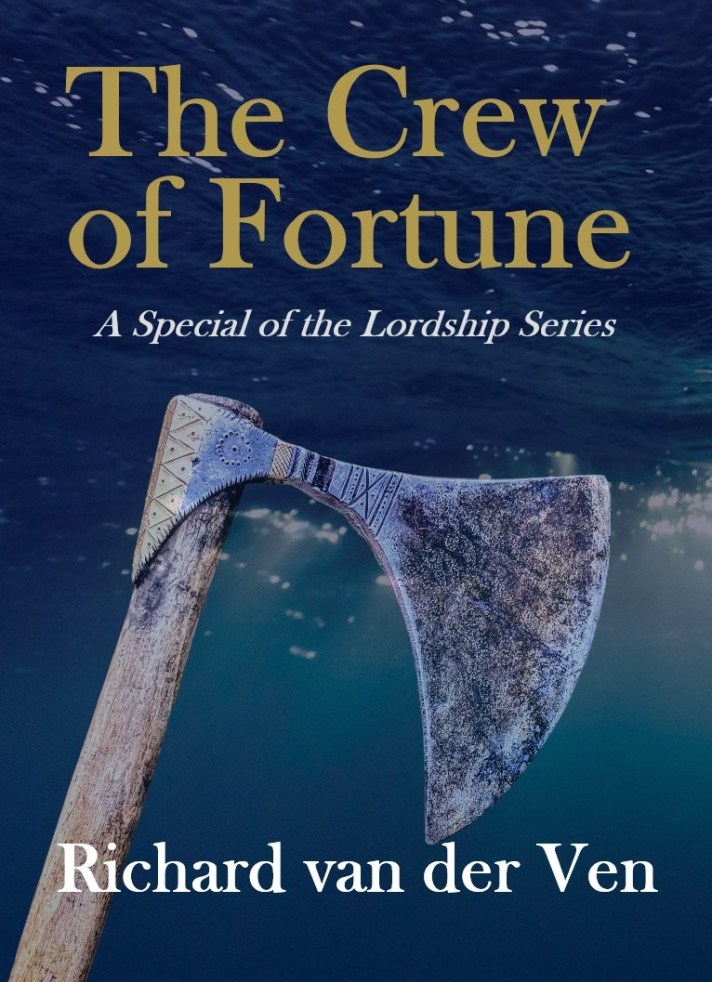
The Crew of Fortune follows some of the last Vikings to the edge of Norse society. Here a young Frisian captain needs to prove himself against unfamiliar enemies in his quest for recognition, glory, and plunder.

 Richard van der Ven