
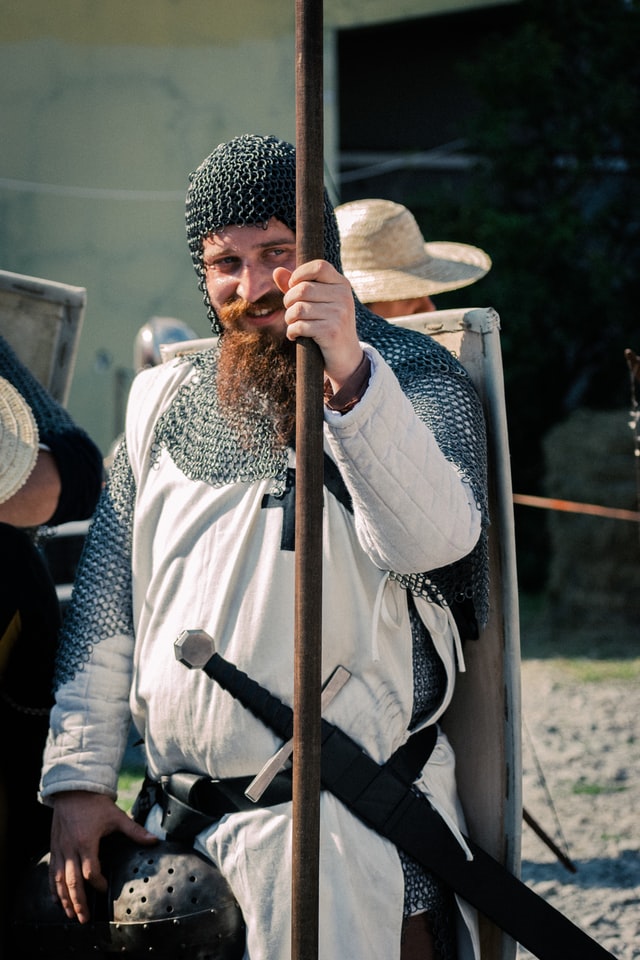
To wonder about the Middle Ages is to wonder about knights. They are often seen as the tanks of this period, the hammer that crushed infantry, archers and annoying rebels, and the flower of the medieval army. Yet what actually made a knight a knight? And where did knights come from? In this blog I will discuss the origin of knights, how they evolved from freemen to a new elite, what they wore and why they lived in castles.
From medieval freemen to knights
First we would have to start with our idea of the knight. In the eleventh century people would actually not be familiar with knights. Instead they would have given the armoured horsemen names such as ‘thegn’, ‘ministerial’ or simply ‘warrior’. In this sense knights were not the really poor peasants but they were also not part of the medieval elite, such as counts or dukes. Instead they simply started as household warriors of the aristocracy, a retinue to guard a bishop, or sentries of a certain stronghold from which tariffs or taxes could be levied. In my book the Frisian, that deals with eleventh century society, we see exactly this depiction of the knight.
A new ‘knightly’ class
The idea of the knight did start to form in this century however, even though the name itself did not yet enter any document of the time. In the Frisian we see a young protagonist, Reginhard, enter the story as a ministerial’s son, a class of unfree men that had overseer tasks, in this case the clearing of lands near the modern town of Dordrecht in the Netherlands. Yet even though this was a ministerial’s main task he also had to serve his lord’s retinue forty days per year as a mailed warrior on horse. And that exemplifies the great difference between an impoverished peasant and a ministerial. The former had to work the land and the latter had to fight for it (as well as overseeing it). It already implied a class difference, and therefore the idea of the knight already existed in that century, and perhaps even the century before. This same class difference was visible all over medieval western Europe, where in England these men, under slightly different circumstances, were named ‘thegns’ and in France ‘seigneurs’.
The fighting knight
Another way of becoming a knight was to serve as a member of a retinue, and usually that meant young men that had yet to earn a piece of land to ‘manage’. In essence an early knight was a young man that did nothing else but train, fight and if lucky survive until he could be rewarded with something better than a position as warrior. As peasants worked the land, this class of men did nothing else than practice warfare or in some cases ‘convince’ the peasants to hand over whatever was demanded by the nobility. In The Frisian I show how the West-Frisian free farmers had to give away more and more of their produce as tax to the bishop and if they did not it was the knights that would come knocking, sometimes literary, the life out them.
What did knights wear?
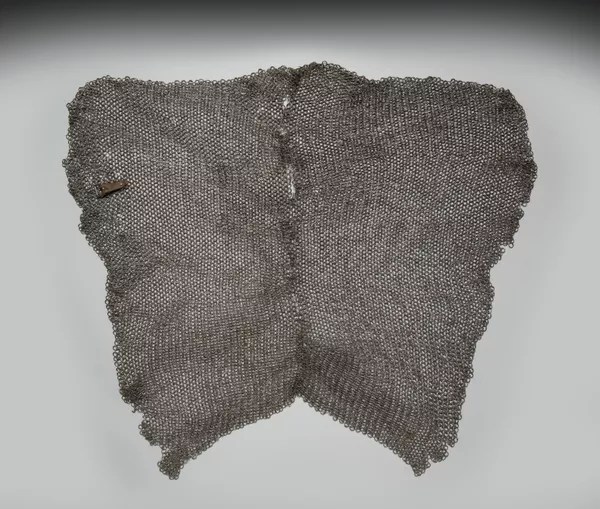
So now that you know something about the origins of knights and where they came from, we still have to explain what made these men actually stand out, and that means answering the question of what they looked like. Early knights were famed for their full enclosure in iron, and that simply meant these were warriors wore very expensive armour. However in the time my book the Frisian was set, the horse warriors did not yet wear the famous plate armour that we often see in our stories of king Arthur. No, instead, they wore mail hauberks that consisted of countless interlinked rings of iron and which was simply the best the times had to offer. It was heavy for sure and protected a man much better than leather or rawhide tabards. It also did a good job of protecting the horsemen against arrows, especially those shot from short bows, which were often not powerful enough to penetrate the mail armour.
Norman and Frankish Knights
Having said that there were regional differences in what early knights looked like. The horsemen from modern-day France and Normandy would have worn long kite shields, because these long shields (which could protect a larger part of a body on horseback) made more sense than round shields. Also, richer areas would have fielded better equipped warriors (as they could afford better armour) and the training of horses for lance charges (which mostly started in the former Frankish empire, which is now France and Germany).
Anglo-Saxons and Vikings as ‘knights’
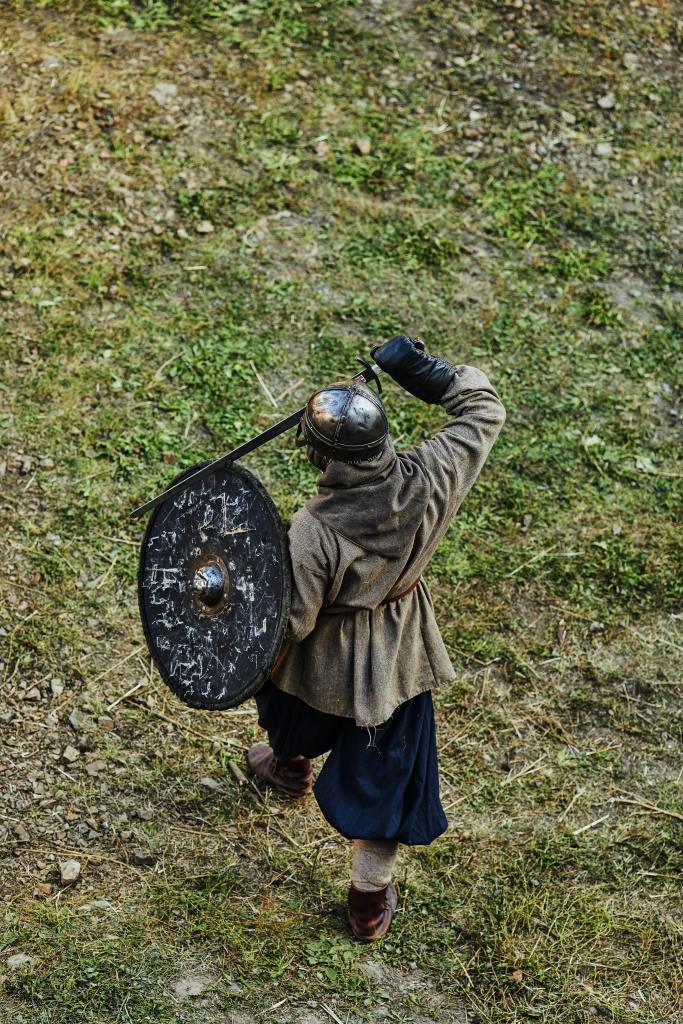
The Scandinavians and Anglo-Saxons from England, however, still fought on foot (even though they often traveled on horse like their continental brothers) and therefore more often wore round shields. Indeed, these were quite effective at forming defensive formations such as the famous shield walls from the series Vikings.
Medieval Welsh knights
In Wales horse charges were less effective due to the hilly terrain and so their feudal warriors, called ‘Teulu’, often threw javelins at enemies. At the same time medieval sources sometimes mention how the Welsh fielded troops that had lesser quality gear and this was probably because they did not have as much access to iron as the Normans for example. Of course this fact would have had an impact on the thickness and quality of armour these Welsh elite warriors would have worn and thus what they looked like.
Why did knights live in castles?
Of course a knight is not a knight without his castle, as this grand structure is almost always intrinsically linked to the mounted warriors of the middle ages. If the former was the medieval tank than the latter was the impenetrable bunker of modern-day air defense. Yet did early knights even have access to castles?
The answer is yes, and sometimes no. In the Frisian we see all the different types of knights and their home situations. The ministerials from modern day Holland would have had nothing more than a large house from which they managed their newly cleared lands. At the same time urban retinues of bishops, for example, would not each have had a castle of their own but rather a simple room possibly located within a castle or a bailey their lord commanded. And English thegns could have lived in fortified halls or simply resided within towns in whatever house they could afford. Finally, the Welsh teulu lived in either a royal palace or in hill fort that their lord inhabited.
Knights in motte-and-bailey castles
In any case it took a while before this class of warriors were appointed their own lands large enough to sustain the building of an early wooden castle, called a motte-and-bailey. In the Frisian we see that the protagonist is able to build his own, very small, motte through a successful career and piece by piece he strengthens it with a tower, walls, and a ditch. And that was all it was at first. A man-made hill on which a tower was placed. Later a small palisade would have surrounded it and possibly later a second wall could be constructed to protect the inhabitants inside (smiths, stables with horses, graneries etc). So in essence a small castle like this could have protected a knight from Vikings (still a threat in the eleventh century) or any enemy that could cross a border (think of castles on the border of Wales or Scotland).
Knights gradually became elite
In the case of a knight’s castle it would not have been too difficult for an organized military force to overtake it. In fact that is exactly what happens in the Frisian as the Welsh overrun Hereford and burn the castle constructed there (which was built by an earl, not even a knight). A knight’s residence was therefore something that could protect his person in the case of a small raid and symbolized his power in the local community. So peasants could gawk at both the protection it could offer them as well as the military presence that kept them in their place. Slowly these castles would increase in size and early knights became more and more part of the country’s elite. Land could be rewarded to those who had fought or even commanded well and so in theory a well trained freeman could become a respectable member of eleventh-century society in the course of his life.
Summary
So even in the eleventh century one could rise in the world, though in reality it was far more likely that the mailed warriors passed on their status from father to son, trying to get the lords they served to grant a position to their relatives. Slowly the knights became an elite in itself and their status increased throughout the middle ages as both land and titles were assembled and passed on. A little bit how it has always worked and how it still works I guess, with an elite passing on jobs to one another. Yet one thing is clear, just as the Frisian shows its readers, knights could be found from Wales to Denmark even if the characters living in that world had no idea what the word meant in the first place.
Photo by Sabin Zablau on Unsplash
Sources
A Late Saxon village and medieval manor : excavations at Botolph Bridge, Orton Longueville, Peterborough
The Anglo-Saxon Chronicle. Eds. Giles, John Allen 1808-1884 Translator; James Ingram 1774-1850 Translator. Project Gutenburg. 1996. Ebook.
Annalen van Egmond. Eds. Gumbert-Hepp, M., Gumbert, J., en Burgers, J.W.J. Hilversum: Verloren, 2007,Print.
Barlow, Frank. Edward the Confessor. Eyre Methuen. 1979. Print.
Bartlett, Robert. The Making of Europe: Conquest, Colonization and Cultural Change 950-1350. London: Penguin Books, 1994. Print.
Blockmans, Wim and Peter Hoppenbrouwers. Introduction to Medieval Europe 300-1500. London: Routledge, 2007. Print.
Brownworth, Lars. The Normans: From Raiders to Kings. Crux Publishing. 2014. Ebook.
Campbell, J. The Anglo Saxons. London: Penguin Books, 1991. Print.
Davies, Michael and Sean Davies. The Last King of Wales: Gruffudd ap Llywelyn c. 1013-1063. Cheltenham, the History Press. 2012. Ebook.
Davies, Sean. War and Society in Medieval Wales, 633-1283. Cardiff: The University of Wales Press, 2004. Ebook.
Dronkers, Jaap etc. Adel en Ridderschap in Gelderland: Tien Eeuwen Geschiedenis. Arnhem: WBooks, 2013.13-24. Print.
Janse, A. Ridderschap in Holland. Hilversum: Uitgeverij Verloren, 2001. Print.
Mack, Katharin. “Changing Thegns: Cnut’s Conquest and the English Aristocracy.” Albion: A Quarterly Journal Concerned with British Studies 16:4 (1984): 375–387. Print.
Van Winter, J.M. “De Opkomst van Ministrialiteit en Ridderschap.” Geschiedenis Utrecht. Ed. C. Dekker.
Williams, Brian. Life in a Medieval Castle. The Mill, Brimscombe Port Stroud: Pitkin Publishing. 2013. Ebook.
Woodman, David. Edward the Confessor. The Sainted King. Penguin Books. 2020. Ebook.
join one of the last vikings on his quest for glory
Get a free historical short story
The Crew of Fortune follows some of the last Vikings to the edge of Norse society. Here a young Frisian captain needs to prove himself against unfamiliar enemies in his quest for recognition, glory, and plunder.


