
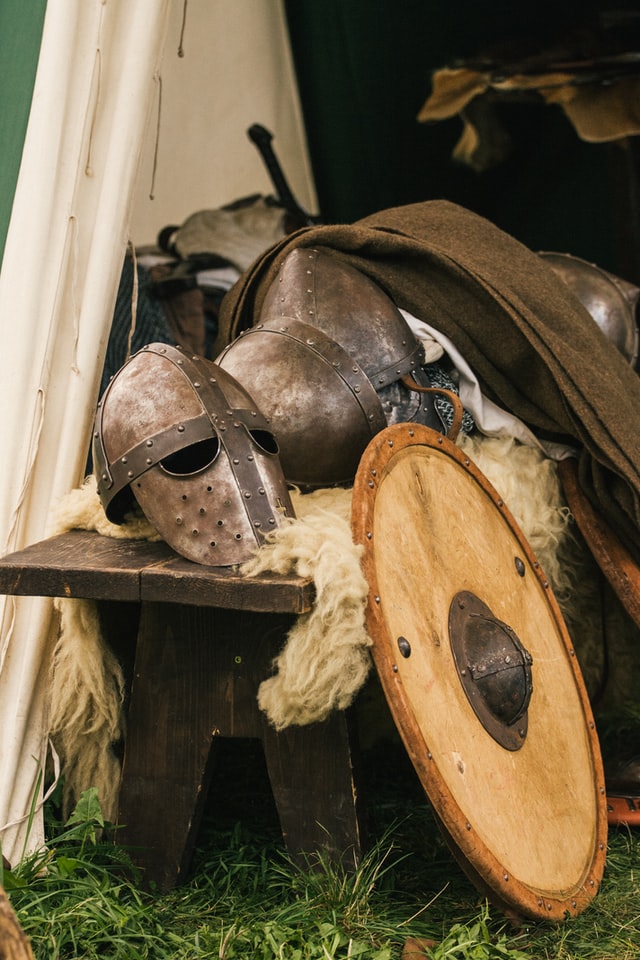
Most of us have a clear picture of knights from the Middles Ages, armored from top to toe in heavy plate and mounted on equally formidable horses. And certainly for many centuries heavy cavalry were a prominent feature on medieval battlefields, with the cavalry charge being one of the most devastating military developments of the Middle Ages. Yet knights were not always armed in plate and the development of this iron encased dread dealing out death started off in a somewhat more primitive form. This blog will discuss how knightly armor developed over time and how early knights from different cultures had different types of armor. It will take a look at forces from medieval Normany, England and Wales. Here you will see that not every region had the same troops that wore the same type of armor.
Medieval Norman armor
It might be most suitable to start this article with the famous eleventh-century Normans, in many degrees the forebears of the later knights. It was the Normans under the command of their mighty dukes that dominated eleventh-century battlefields with heavy cavalry charges and mailed warriors bearing lances, even though the Franks and Germans also employed these tactics and fielded similarly equipped troops.
Medieval chainmail
In fact the heavy cavalrymen wore what is called (chain) mail armor (many rings excellently forged and linked together) to protect themselves against missile fire and infantry weapons. In an age where iron was not easy to come by and the forging of such specialized iron armour was extremely difficult, these hauberks (see picture below) were invaluable to any warrior riding into battle. Because the men rode on horses they needed longer mail coats to protect their legs, and these were protected further by leather boots and sometimes a layer of mail attached to that as well. On their heads they wore iron conical nasal helmets that were distinctive enough to recognize a Norman when a victim was unlucky enough to encounter them. Since these fighters needed both mobility and protection they also used what is called a kite shield. These shields were long and pointy, made to be the best possible protection when a man is sitting on a horse but also needs space to couch his lance.
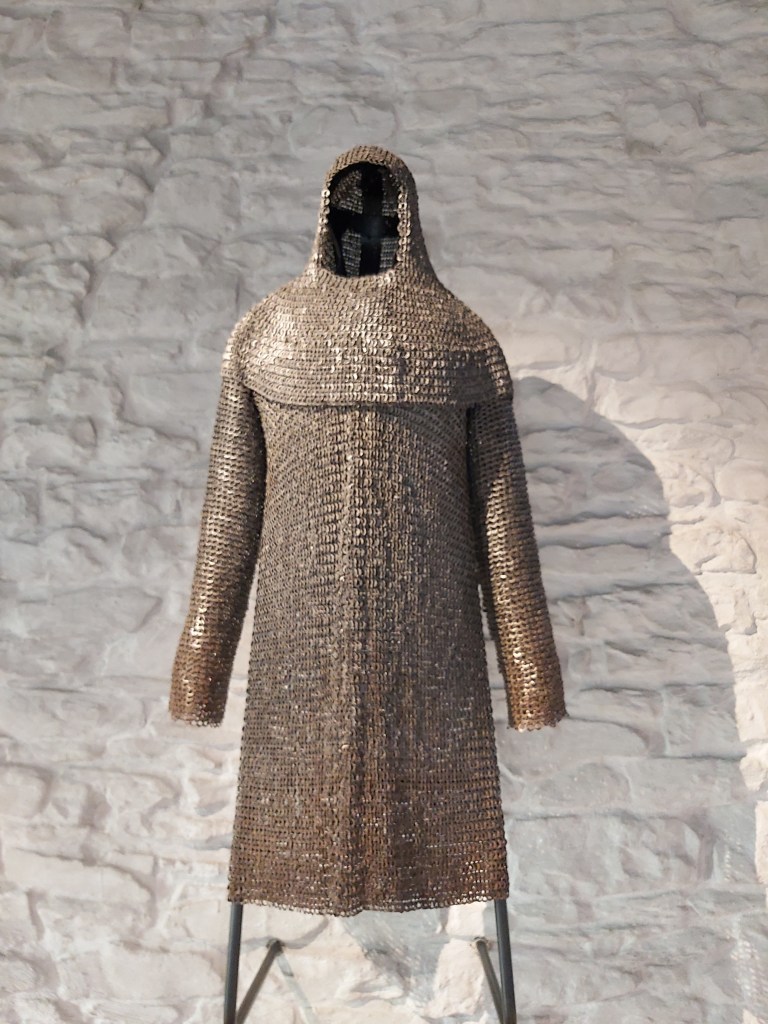
The point here is that plate armor was not developed yet as smiths were not yet able to forge such sophisticated protection in that age. However the idea of the knight, its social class and a sturdy iron suit of armor were already common features of eleventh-century battlefields and so what one would encounter there might not have been so different in essence from the later knights who jousted magnificently in their ornamented plate cuirasses.
Anglo-Saxon armor
So was there a difference between armor worn by the English, or Anglo-Saxons, and their continental counterparts? Well, as we could already read in my blog about knights, Anglo-Saxon England fielded heavily equipped troops just like their brothers from France and Normandy. Yet a visible difference was seen in helmets and shields. Indeed, when William of Normandy tried to beat an Anglo-Saxon army in 1066, fielding heavy cavalry, the Normans stumbled on a massive defensive line of warriors fighting on foot. These English ‘thegns’ had ridden there on horseback but had dismounted and overlapped their large round shields to create an almost impenetrable line of defense. Since their tactics were based on such shield walls, we see their armor also showed slight differences compared to the Normans.
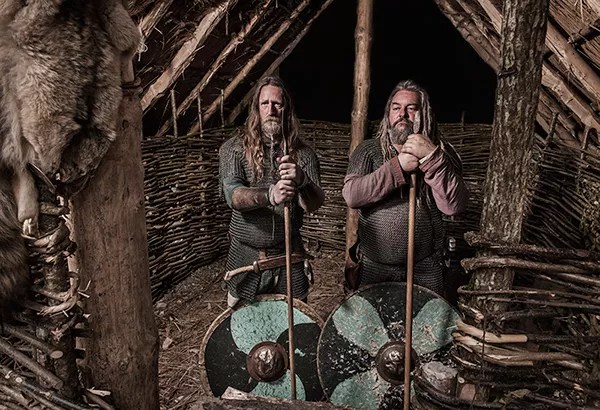
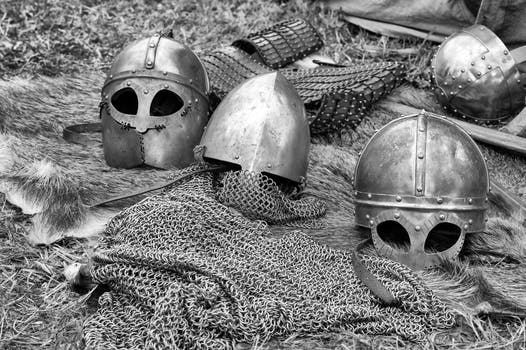
It is improbable that their mail protection was much better or worse than the Norman hauberks. However Anglo-Saxon helmets have been found that show quite distinct features as they had a form of iron goggles to protect the face and seem to have been rounder in shape than the Norman counterparts. This feature made the warriors look like they were wearing masks and could have been extra frightening to enemies.
Evidence for Anglo-Saxon armor
Unfortunately, not much is left of Anglo-Saxon armor and so archeological evidence is scarce, which means they could sometimes have worn similar types of armor to the Normans, certainly when the thegns (early English knight) would ride into battle and a kite shield was more practical. It is a fact that even before the Norman Conquest there were already several (high) continental nobles present in England and they would certainly have brought continental armor with them as well. Indeed, the Bayaux Tapestry, that famous reminder of the battle of Hastings, does not alwasy seem to differentiate between Norman and Saxon horsemen in its depictions of both groups. It is possible that the artist did not care about any differences but it is at very least likely that the differences between these groups were in fact slight, and mostly visual rather than technological. Still, even though the cavalry display kite shields, in the scene depicting Normans slaying king Harold’s brothers, suddenly some round shields pop up, indicating Saxon infantry did use the heavy round shields.
https://www.readingmuseum.org.uk/collections/britains-bayeux-tapestry
Medieval Welsh armor
The Welsh were a people encountered both by the Anglo-Saxons and the Normans, as they inhabited both groups’ borders. Again not too much is left of medieval Welsh armor from the eleventh century but some documentation does give clues as to the quality of armor these men wore. As expected the Welsh footmen likely wore light armor, just like most supportive troops in all three groups discussed here. However there was also a group of men that was the Welsh version of the early knight, and they were called the Teulu. Usually guards or private armies of noblemen they had basically the same function as the heavy cavalry from the other groups, and so they likely wore similar armor. However, as my book the Frisian reveals, the Saxons and Normans encountering the Welsh remark on their lesser quality gear, and this was documented as well by a thirteenth-century chronicler, called Gerald of Wales. Even though he wrote in a later time, when armor had already developed more, he mentioned that the Welsh generally wore less heavy armor than their Norman counterparts. An explanation for this fact is given by Davies, who suggests that due to iron being scarce in Wales, the Teulu likely gained armor anyway they could, like looting it from fallen enemies. This could have explained why the Teulu would have been regarded with scorn by Normans who were quite used to knights wearing decent hauberks, not some randomly assembled mix.
Link medieval armor and tactics
What is interesting is how medieval armor was also linked to tactics. As Gerald of Wales mentions the Welsh he also suggests that their tactics were more of a hit and run one, retreating whenever an enemy seemed too strong and striking fast and quick whenever possible. With such tactics it is not so strange that it made sense for the Welsh to have lighter gear, so as to be more mobile. In fact, the same Gerald mentions how earl Harold, in 1063, had beaten the Welsh by being like them, wearing rawhide boots and light tabards, chasing the Welsh with enormous speed, taking them on in the same way they themselves fought. This remark shows that the terrain of Wales made their commanders adopt a certain strategy and the hilly region was not very suitable for heavy cavalry charges. Logically, it would have made sense to wear lighter armor then, although what precisely they wore is not very clear and it could have varied greatly on their wealth and manner of acquiring war-gear. Indeed, Davies states that most troops would have worn leather, and iron armor was only for the richest of the Welsh.
Summary
This article has told the tale of the early knights and what armor they wore, taking into consideration that formally knights did not ‘exist’ in the eleventh-century, although the men that rode into battle wearing armor were quite clearly a distinct social group with considerable rights and privileges. As the Anglo-Saxon elite was replaced by the Normans after the Conquest the development to a feudal system would shape these knights more into the form known today. However all groups wore quite similar armor in that era, and even though it would take another three hundred years for chain-mail to develop into plate armour, it is clear that horsemen were heavily protected individuals and quite up to the task of fighting their entire lives. The possible lack of high quality iron in Wales could have made the people here wear slightly less heavy armor. Yet tactics played a role on the composition of armor as well, and difference between all these groups were still relatively small. Unsurprisingly they all kept fighting and gaining honor to increase their stature and as technological advances enabled better equipped forces, the knights of the middle ages took their famous shape and became forever implanted in the memory of our western societies.
Photo by Michal Matlon on Unsplash
Sources
The Anglo-Saxon Chronicle. Eds. Giles, J. A. (John Allen) 1808-1884 Translator; Ingram, J. (James) 1774-1850 Translator. Project Gutenburg. 1996. Ebook.
Bartlett, Robert. The Making of Europe: Conquest, Colonization and Cultural Change 950-1350. London: Penguin Books, 1994. Print.
Brownworth, Lars. The Normans: From Raiders to Kings. Crux Publishing. 2014. Ebook.
Campbell, J. The Anglo Saxons. London: Penguin Books, 1991. Print.
Davies, Sean. War and Society in Medieval Wales, 633-1283. Cardiff: The University of Wales Press, 2004. Ebook.
Davies, Michael and Sean Davies. The Last King of Wales: Gruffudd ap Llywelyn c. 1013-1063. Cheltenham, the History Press. 2012. Ebook.
Gerald of Wales : Instruction for a Ruler (De Principis Instructione). Ed. Bartlett, Robert. Oxford, Oxford University Press, 2018. Print.
For the Bayeux Tapestry I suggest you visit https://www.readingmuseum.org.uk/collections/britains-bayeux-tapestry or of course go there in person.
Links for further reading
https://www.medievalwarfare.info/armour.htm
https://www.thecollector.com/evolution-medieval-armor/
join one of the last vikings on his quest for glory
Get a free historical short story
The Crew of Fortune follows some of the last Vikings to the edge of Norse society. Here a young Frisian captain needs to prove himself against unfamiliar enemies in his quest for recognition, glory, and plunder.

 Richard van der Ven